Sunday, June 4, 2023

London, Ky. ASA


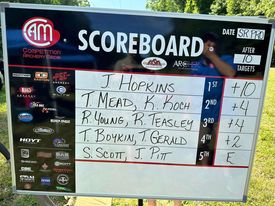
The only reason I chose to start this entry with this picture is to remind myself that I have the ability to shoot my bow mistake-free throughout high-pressure rounds. I've been struggling with that this tournament season, and I realize I need to get back on track. My focus will go toward improving that area of my game to allow me to shoot rounds like the ones I shot that allowed me to win the patches in the picture above.


    After getting home from the First Leg of the IBO National Triple Crown, the cuts were still bleeding, and the burn could be felt from the inside out. The phantom lows ate at my craw through the midnight hour, and my mind raced to find an answer. 

  Over the course of the week, I found a few answers, but I wasn’t sure if the things found would lead to an A on the next report card. My timing was still good, as nothing had changed. Jacob and I took my cams off and checked the bearings… everything was good. The creep tune on the bow was good, with arrows hitting with each other under all circumstances. 

  Then, as we were sitting around BSing about different things, Jacob took a nock and slid it up and down on my serving under the loop. The nock barely budged without help. Although I had noticed the same thing throughout the year, I never paid much attention to it. A few years back, Jacob said he had the same issue with nocks on his arrows. Although he was shooting acceptable groups, the groups weren’t what he thought they should be… the same feeling I’ve had. 

  After changing nocks, his groups tightened. Well, mine did the same. I changed from an Easton G pin nock to a Beiter hunter, and the results could be seen instantly. Over the course of the last two weeks, I decided to shoot a 70-pound bow and overdid it. I basically blew my shoulder out and was unable to draw my normal bow for five days. I got a knot in my upper back/shoulder, which runs into my neck. I also have a lot of pain across my collar bone. It is not pleasant, and it’s making drawing, aiming and shooting the bow extremely difficult. 

  While around many people with different rangefinders, I also learned that my rangefinder reads an average of 2 to 2.5 yards more than everyone else’s. Instantly, I knew I had to rectify that problem and go back to my dinosaur rangefinder. Jacob and I have always had the same numbers, and I’ve noticed that his numbers have been consistently two yards short of my numbers the entire year. So, some of the lows could’ve been from the target being at 50 yards on someone’s rangefinder, which would’ve been 52 on mine, then if I set my sight at 48 to hang a 10, I could’ve shot it for 46 when it was 50. The result of that is a low 5 on every shot under those circumstances. 

  We got a late start due to Dad losing his phone. Shortly after getting on the road, we were in the middle lane of I-87 when a tremendous bang shook the truck. My heart went into my throat, as it sounded like a gun bast. However, we quickly realized a tire had exploded on a tractor-trailer in the lane next to us. I always know that traveling creates risks, and none of us are guaranteed tomorrow. That’s why I try to make the most out of every day. 

                                                                   Practice Day

  I’ve never enjoyed shooting in London, Ky., and it’s probably not for the reasons why so many others don’t like it. It has never given me the feeling that is associated with a big tournament. It always feels as if it’s something that someone sets up in their backyard to invite their friends over to see which one of them they can piss off the most. Although everyone must shoot the same targets, the timing is crucial on these ranges as to when you shoot each one. In a 20-minute stretch, one group could have no problem seeing a target, while another group may find it merely impossible. 

  Anyhow, practice wasn’t the best. My shoulder was still in a tremendous amount of pain and aiming the bow with any type of steadiness was all but impossible. I focused on getting good numbers and making the best shots possible. 

  By the time we finished, I probably ended up shooting a total of 40 arrows for the day, so in the previous week and a half I launched no more than 60 arrows. 

                                                                      Day 1

  With the shoulder issues lingering, I shot eight arrows to warm up before my round and called it good. Last week all the pros got an email that stated things were going to change with range assignments due to complaints about integrity. I laughed and predicted the future. They were going to give our ranges different letter numbers than normal so nobody could share numbers between each other from day to day… comical. Yet, in the meeting before we started, they said that unknown shooters would not be shooting any known ranges. Well, Einstein, there is only one other unknown pro range we could possibly shoot… the one we always shoot… the one that Open Pro shoots on the first day. How about just moving 7-10 stakes between days. The stakes only have to vary about 3-4 yards. It doesn’t take any time, and that would eliminate any advantage people would get if they actually shared numbers. Nope, why do that? C’mon, how about having integrity as the business setting the courses. Employees in businesses are paid to work. Changing a handful… or all … of the stakes would take minimal effort and time. Although I could go on, but that’s my rant about that.

  I started my day on a deer and made shot a good shot, just missing over the 12. Amazingly, the bow sat down nicely, and my shot felt powerful. In the next four targets, I made smooth, effortless shots and got three 12s. After five targets, I was sitting at +6 and feeling confident. In the next 10, my shots continued breaking effortlessly and the pin continued holding steady. I barely missed a few and had a glance-out on one before taking my first 8 of the round to find myself sitting at +4 after 10. However, I realized that I stopped playing the game the same way I started it. Now, I found myself playing to not lose points rather than playing to gain more points. I began getting a little defensive instead of playing offense and controlling play. Then, on target 14, a wolverine, I heard an arrow and knew the target was in that 48-50 range. It was a no-doubter. Although I didn’t make the best of shots on it, it wasn’t too terribly bad. When the arrow hit, I didn’t like the sound. Looking at it through my binoculars, I could see it sitting below the 8-line. It was my first marginally bad shot of the day, and it made me pay the price. I earned it. Even with the 5, it only put me at -1. I felt I could make a comeback over the next six targets and finish my day on the plus side. With a few targets left, I missed one to the right, with another marginal shot, but I finished the day barely missing two 12s. The group thought both were 12s from the stake. 


  At the end of the day, I sat at 3 down, but my shooting played out better than the scorecard showed. Heading off the range, I was disappointed, but I was also satisfied that I gave myself a chance going into Day 2. I shot with Joe Pitt on Day 1, and we usually shoot well when we shoot together. The same played out this weekend. We both stayed afloat and found ourselves within reach of the leaderboard. Joe always keeps the group loose, and I find it easy to shoot with him. I enjoy his company in my group, and I always feel at ease when I learn we will be sharing the same stake. While it’s easy to shoot with some people, others can make for a long day. 

                                                                                  Day 2

  Heading into day 2, I figured if I could get back to even, I would have a great chance at making it into the shootdown round, and I knew my shooting was on par with achieving that. Once again, I only fired eight shots at the target butt before the round.

  When I got to the target, a black panther, I felt good about my starting position. After the cards were drawn, I learned I would be shooting last. The panther was close, and I knew I would go after the 12. However, with it being a little dark out, I must’ve aimed a little too low while also seeing the yardage a little short. I started off with an 8. It’s never a good thing to go backward when you’re on one of the closest targets you’ll see during the round. 

  When I got to the next stake, the target at the end of the lane was a leopard. After hearing a few arrows, I knew it was a bomb. I set my sight and aimed for center 10. Before drawing the bow, I turned my light on, and the pin was huge. At full draw, I had a hard time seeing beyond it, but I lazily ignored it and figured it was OK. After all, I knew I could shoot the arrow in the 10-ring without any problem. 

  When the shot fired, I felt good about it until Digger Cogar told me it hit to the left. I guessed that it probably hit right where the pin was sitting. I knew better than to shoot the arrow with the light on the brightest level, so I deserved the 8. I was simply complacent and ignored something that was obviously going to hinder me from putting my best effort forth. 

  After pulling the arrow from the target, I knew I had to buckle down to stand any chance of saving face. From that point forward, I went on a roll, but I couldn’t catch a 12 to save my life. Nearing the end of the round, I came upon another bomb of a wolverine. This time I made sure to aim above the color change on the target. That’s when I realized I had probably been aiming in the wrong place on it. It felt like I was extremely high on it, and it gave me an uncomfortable feeling. That feeling overtook me at full draw, and the shot got squirrely in a hurry. Before I could save it, the pin started dashing and the bow fired. It resulted in a less than desirable score, but I finished the round strong. I went into day 2 in 14th place and that’s basically where I finished. Although the final tally says 16th, it’s because two guys who had the same score shot more 12s than me. 

                                                               My Final Take on the Weekend

  In all reality, I didn’t expect much from this weekend. After injuring my shoulder, I was nowhere near where I needed to be with my shooting. It’s difficult to aim at 12s when you can’t hold the bow steady enough to hit them without paying the consequences along the way. The injury makes me wonder if my shoulder will recover enough to be able to hold well this summer. I haven’t shot without pain since having reconstructive shoulder surgery, but this pain is up a few notches from normal. Time will tell. 

  In all the ASAs this year, I’ve gotten off to a good start. However, I’m getting behind the 8-ball with a bad shot here or there that I’m paying the price for. The bad shots aren’t remotely close to scoring double digits, with most of them resulting in ugly 5s – even uglier than they appear on the scorecard. 

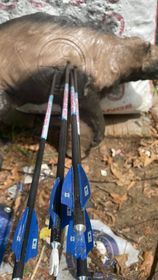
  I’m shooting well enough to be at or near the top at the end, but I need to find a way to avoid making two to three bad shots per tournament. In the last two tournaments, they’ve occurred on max-distance wolverines, so I walked by the target trailer and made an impulse buy. I bought the wolverine to ensure I don’t shoot a 5 on it again. When I got home this morning, I took four shots at it from 50 yards without any practice. This is the group. I’m pretty sure I’ve been aiming way too low. When you add that to a bad shot, the result is disastrous. I’ll make sure that does not happen in Metropolis. 


  Even though I faced physical limitations this time, I still expected to do better. I could have almost no use in one arm, and I would still think I should do better. I don’t believe there is any reasonable excuse for not doing well. Then again, I do feel blessed to be able to compete at the level I compete at and do well at times. I know there are many people who would kill to be able to do the same. I guess in some ways that must makes me a lucky person. I’ve put the work in over the years, and many times it just doesn’t feel like it adds anything to my game. While I’ve gained the respect of my peers, I need to do more for myself. I’m not satisfied with the way things have played out over the last year. My shoulders have gotten progressively worse, and I’m not sure how much archery they have left in them, especially at the highest level of competitive archery. I’ll keep trying, though. 

  Coming home, I stared out the window and felt like punching a hole through the glass. Then I felt like ripping my new wolverine out of the back of the truck and punting it like a football. All I can tell you is that everyone goes through ups and downs and faces challenges, even the best. 


  Sometimes you talk with your peers during and after events, and you discuss different things. After this one, I was talking to Tony Tazza, and he was telling me he feels like he’s shooting the worst he’s ever shot, and he’s having issues hanging up on his release and just watching the pin sit there without executing. People think that pros never have any issues because they somehow find a way to never dip too terribly low. We all face the same things everyone else faces. Experience just teaches people how to navigate the bumps in the road. I encourage all of you to remember this when you’re feeling down. I must remind myself of this right now. 


  This year has been a learning curve, and the curve seems to be getting wider and wider, and I can’t see around the bend in the road. I’m hoping there’s a straightaway once I clear the wide sweeping curve. I’d like to mash the pedal to the floor to race to the checkered flag. I just need to keep the wheel tight and lean into the corner until I get through it. 


  I’d like to congratulate my dad, Wade Chandler, and Mike LeFevre. They all shot well in Kentucky, and it was good to see them gain some confidence and be rewarded for their efforts. Mike called me earlier in the week and asked for some advice. I gave him a little direction that I thought might help him, and it worked out well. I was glad to see that he stuck to the plan and accomplished his goal. Way to go, Mike!! 

My final thought of the week as the national 3D tournament season hits the halfway point:


Sunday, May 28, 2023

Judging the Distance with Jack Wallace

  With the ASA in London, Ky., bearing down on everyone, Jack Wallace has decided he wants to help people improve their game of shooting in the unknown classes. Recently, he contacted me and wondered if I might be willing to transfer his thoughts into a written piece that could be referenced by shooters for years to come to help them become more proficient at the "game" we play. While unsure if I could navigate the process and get it into a readable form that didn't take up too much time from the readers, I ensured him I would give it my best attempt. Here are the highlights of our recent conversation. I hope everyone is able to gain something from Jack's knowledge and go to the next level in their shooting. While he has helped many shooters, amateurs and pros alike, some stand above all others, including his wife Sharon, and the mystery Jack in the Box open pro shooter whom we will introduce later in this article. 

  A while back, Levi Morgan, whom many consider to be the best 3D archer of all time, was on a Bowjunky podcast speaking about judging yardage. In the course of the conversation, Levi made reference to Jack Wallace, saying Jack is the best yardage judger he has ever shot with, even though his shot might get a little squirrely now and then. Coming from the greatest of the greats at the game, it would probably be in everyone's best interest to learn from the greatest of the greats yardage judger. Not only has Jack's methods for judging yardage withstood the test of time, his shooting often goes unnoticed when compared to the other legends. Jack is also a legend, and that should not be forgotten. He is one of only four Open Pros who have ever won the ASA Classic, ASA Shooter of the Year, the IBO World Championship, and the IBO National Triple Crown. Can you guess the other three who have accomplished it? They are none other than Jeff Hopkins, Levi Morgan and Danny McCarthy. Now, it's time to share some of Jack's secrets that helped him on his journey to amass all those titles and many more.    


                                                                                             Jack's Early Years

    Jack started shooting his bow in his backyard with his dad in 1982 at 7 years old. Living in Ohio, Jack and his dad practiced to become better bowhunters, and as they became Roger Staubachs in their own backyard, another archery game was being born. Field archery, as it was in so many places across the country, was experiencing a sharp decline in numbers, and 3D tournaments quickly became commonplace. Unlike field archery and indoor archery, which are both shot as "rounds" and based on perfection, 3D was a game in which two wrongs could make a right or two rights could end with a displeasurable result. In this new game, you might be shooting great but judging poorly or you might be judging great and shooting poorly, resulting in scores that seemed impossible for your level of shooting on that day: the glory that goes with playing this "game."

  Jack fell in love with the game because of all of the nuances associated with it. He played sports growing up and knew he didn't have the athletic ability to be a professional athlete in one of the big four sports. However, he saw 3D archery as a discipline he could master if he put his mind to it, so he threw all of his eggs in that basket and decided he would come up with a program to chase his idols, Randy Ulmer and Shannon Caudle. If he mapped it out correctly, he thought he might have a chance of rubbing elbows with them and dancing with them on the big stage. 


                                                                                             Turning Pro 

   In 1994, as Jack watched his idols at the ASA Classic, he made the decision to jump headfirst in the shark pool the next year. In 1995, Jack came out of the gate swinging and clawed his way through the year. He drew his bow day after day and month after month until he found that first year coming to an end. Although he fell short of his goal of being the Rookie of the Year and finished as the runner-up, he found the motivation to focus on the discipline he needed to get better and give the big dogs a fight for their lives. He would create a game plan and try to stick to it to ensure he could stay in the 10-ring and pick up the bonus rings he would need to win. The new approach would focus on two things: JUDGING YARDAGE and CREATING A GAME PLAN to be there at the end of each event. 

                                                                                            The Turning Point

  The 1996 season was upon Jack before he could bat an eye, and he was ready for it. Going into the season, Jack was in college, and neither he nor his family had the money to afford any targets. Instead, he and his father would shoot in the backyard at the target bag they owned and one deer target that could be found next to the bag. 

  At the first ASA tournament of 1996 in Gainesville, Fla., Jack found himself at the top of the Open Pro class, winning his first professional event. His taste for victory honed the discipline he would need to keep moving forward and stack up one of the most illustrious careers ever for any shooter who has competed in the Open Pro class, where he still competes today. 

  Not being able to tell the future, he headed to the next event in Georgia, and a fella named Jeff Hopkins won his first professional event. The first two events of the year were won by shooters who had never tasted victory in the Open Pro class. Jeff went on to run the table for many years and quickly became a dominating force, and Jack continued trying to master the game and figure out the best way to play it. 

  As 1996 wore on, Jack found himself in a tie with his idol, Randy Ulmer,  for ASA Shooter of the Year. The tie continued through a few shots, until Jack's final arrow found the 12-ring and the ASA presented  a $50,000 check to a 21-year-old kid from Ohio. He had worked his plan thoroughly and he stayed disciplined with the yardage judging to earn the title of being the best ASA professional shooter for the year. He's grateful for all of the opportunities archery has given him, and he's thankful to have represented many of the best companies in archery. The shoot-off against Randy Ulmer is what Jack explained as his "big break" in archery. Over the years, he has realized that the equipment people choose to use is not nearly as important as judging distance. Judging distance is part of 3D archery, one of the only disciplines in the archery world that can be considered an actual game. 

                                                                                  Jack's Rules to Judging Yardage


   You must be able to determine the depth to the target. Some people do this by using the ground; some people do it by target recognition at different distances. There are many ways to do it, so you have to figure out what method you're going to use to determine depth. 

 Some things to keep in mind while doing this. It is true that the targets never change. However, southern Alabama foliage, big oaks in Illinois, the hills of Kentucky, and the Black Forest mixed with plantation pines in Cullman all present different challenges. In theory, being able to recognize the target or correlate it to something else in your mind will be the best way to determine the depth of each target. 

MAKE SURE YOU KNOW THE. YARDAGE BEFORE YOU GUESS IT! -- We can't answer a math problem without knowing what the symbols and formulas mean. The same holds true with estimating yardage. You need to know it before you guess it.  How do you do this?

When Jack had a target bag and one single target, he and his dad set one brick in the grass at every 5-yard interval out to 40 yards. They would study the bricks and learn to let the mind's eye see (or feel) the distance between the bricks as the distance increased. Then, after shooting groups of arrows, they would take turns pulling arrows. When his dad pulled arrows, Jack would study his father's figure (a human) at the 40-yard bale. Then, on the next end, Jack would pull arrows while is father stayed at the shooting line. After pulling the arrows, Jack would turn and study his father's figure. He quickly allowed his minds eye to recognize 40 yards. 

  So how does this work? No matter the situation, Jack's mind's eye learned to associate his father's figure at a certain distance. It doesn't matter whether it's a coyote or an elk target, Jack pictures his father standing next to the bag. On each stake, Jack still sees his dad standing there. You have to find something your mind's eye can recognize and put into action. 

  Having worked with many people over the years, there are a variety of things people have used to have the same effect. One of his friends pictures his dog, another student was familiar with 4-wheeler tires, so he used them. Then again, another guy who was a drywaller  used 5-gallon buckets. Five-gallon buckets can be used to perfect your skills if you go to any of the local outlets that might have colored buckets. You can buy three or four different colored buckets and put them at key distances to get used to them. Your orange bucket could be 40 yards, your white bucket could be 45 yards, and your blue bucket could be 50 yards. Learn to know what each bucket looks like at each distance. 

  KNOWING HOW FAR THE TARGET IS NOT IS THE MOST IMPORTANT PART OF THE EQUATION

By using something that is easy to recognize in the mind, you will be able to break down a cap of where the target is located. You know it's between the  40-yard orange bucket and the 45-yard white bucket. Then, you determine which bucket it is closer to and set your sight accordingly. You must know the rise and fall of your bow to allow yourself to stay in the 10-ring. 

  There are many theories and plans that people use in the unknown 3D game. Jack encourages people to use what they feel works the best for them. He warns against using the ground game, simply because in IBO tournaments the ground is taken out of play regularly. While you can learn to judge in 5-yard increments, he advises against getting stuck in that rut due to the simple fact that as the yardage increases, your mistakes can get larger and larger if you messed up one of the first guesses. 

 EVERY SHOOTER SHOULD HAVE A BASE YARDAGE

  Every shooter should learn a yardage that they can look at something and know automatically that it is "their" base yardage. Jack recommends 30 yards because that will be closer to your average numbers in most adult classes. If you can start at 30 yards and know that distance, you will have a head start because your overall number to guess will be narrowed into a 20-yard window if you're shooting in a 50-yard max class. 

PERCEPTION

Targets in tunnels may look different than targets in a field. Targets in tunnels may look different than targets in open hardwoods. Black targets may appear farther away, and white targets in beaming sunlight may appear much closer. It's crucial to not assume things when looking at targets. We all know that when we ASSUME, it can make an ASS out of U and ME. Don't assume if you can see the scoring rings on a target, the target is a certain distance. Who knows, the lines in the mold could've been cut deeper, making the lines appear better, or the lighting might be better than normal.

  THE DECISION TO SHOOT

  When a person decides how far the target is from the stake, there are still many things that need to be done to ensure the arrow stays in the 10-ring. Where are you going to aim? How large is your average group at the distance your sight is set?

  Your eyes will always attract to a spot on a 3D target. It could be a nock; it could be a shot-out spot; it could be a shadow. Once your eyes attract to a spot, you need to determine where the scoring ring is. Where you're looking is usually where you will be staring, and where you're staring will sometimes be where you end up aiming. 

  This is where setting your sight and knowing where you're going to aim become vitally important to staying in the 10-ring or hitting a bonus ring. Knowing your average-size group is important because you can't hope for that one perfect shot. Instead, you need to make sure every arrow you fire will stay in the 10-ring so you're not going backward. To be able to shoot a 12, you must be able to shoot a 10 first. 


 Many people will aim directly at the 12, even though 1/3 of the arrows they shoot in a group at that distance will not be in the 12. This is where setting your sight is crucial. You need to know your tendencies, and if you're not comfortable shooting at an upper or lower, you need to make sure you set your sight accordingly. As Jack's good friend Danny McCarthy says, "Make sure you give it enough to get there."

  DO JACK'S METHODS WORK FOR EVERYONE, AND HOW LONG WILL IT TAKE?

  In 2014, a young boy, a girl and the dad contacted Jack for lessons. When Jack asked the boy what he wanted out of the lessons, the boy said he wanted to win the ASA Classic. After getting to the first target, a black bear, on Jack's range, the boy went through his routine and Jack made him vocally announced his steps. Watching the kid step to the stake, Jack heard, "30 yards," and the kid began setting his sight. Meanwhile, Jack knew the target was all of 34 yards. The kid executed a perfect shot, and the arrow landed in the 5. He was a solid 4 yards short. 

  Baffled, Jack asked the young man if that's how he does it every time, and the kid responded, "Yes. I set my sight and shoot right at the 12."

  After that target, Jack asked him to try it his way, the way that was just explained above, and the kid shot eight 12s and three 10s on the next 11 targets. The boy was amazed, and his dad was beaming with happiness and pride. Later that year, he would go on to podium at the Classic. Then, he continued working with these methods and ended up winning his way out of Open C, Open B, Open A and Semi-pro, eventually winning Rookie of the Year in the Open Pro Class. Today, that young man is still shooting in the Open Pro class and giving the man who gave him a plan a run for his money. Discipline and sticking to the plan are what allowed Sam Smith, the Jack in the Box, to appear in shootdown rounds in the ASA Pro-Ams. Jack could't be more proud of Sam and his dedication to sticking to the plans laid out for him to be successful. Everyone milestone Sam achieves, Jack is transported back to his younger years and celebrates Sam's success. Sam might not be a world-class target archer, but he has become very proficient at playing the "game" of unknown 3D. He has become a "gamer" and one to watch. 


  The plan given to Sam can be used on upper and lower 12s and is based on how far the target could be and could it be 1 yard farther than the guess or even a 1/2 of a yard farther. The safe bet is to add another yard. It's essentially important to never fire a shot wondering if you're going to hit high or low. If you're shooting at a low 12, make sure you're never going to miss low, and the reverse holds true for the upper. No matter what you do, the sight has to be set so you stay in double-digit scoring. This will always give you a chance to succeed. You don't have to be one of the greatest shots on the planet to play the unknown "game." It's a game, and the winners are the guys who played it the best on that given day. Unknown 3D is not a game in which you cannot miss. It's a game that you devise a plan to find a way to get more points than your competitor, and, yes, many days you get there when two wrongs make a right, as Tim Gillingham says. Just learn how to play the game.

UNDERSTANDING THE GAME

 There are two days of scoring in every tournament, and there are 40 targets to determine who gets into the shootdown round. Everyone has things they're great at, but everyone also has limitations. Don't play every target like you think your competitors are playing it. It's a game, and your decision-making is what will ultimately decide the result. In Monopoly, if you buy up Park Place, Boardwalk and the Railroad Crossings, then run out of money, you might find yourself in trouble if you end up in jail without a Get out of Jail Free pass and no money to pay the other players if you land on their properties. Unknown 3D archery is the same. Play smart, and stay a step ahead of everyone else by sticking to your plan. 

  Using the Open Pro class for an example, you do some research and learn that 24 up will most likely get you in the shootdown round near - or in - the lead. You don't need to shoot 24 up on Day 1. You don't even need to shoot 6 up in the first five targets. You're going to be on the range for about 3 1/2 hours, so take your time getting to where you want to go. In the first 1:45 you're on the range, try to get to 6 up, so you will be halfway to where you need to be. Then, in the next 1:45 you'll need to pick up 6 more points someplace. There's no sense in coming out of the gate and gunning at every 12. It's much smarter to look at the hand that you've been dealt and play it accordingly. Follow the plan, set the sight to stay in the 10-ring, and take the 12s that come along with your ability to play the game better than others who are going for broke and trying to buy up all the Park Places and Boardwalks in the game then run out of money because the reward didn't have tie to match the risks. 

  It's important to know your equipment and the rise and fall of the arrow at the average distance the targets are set on your courses. Using a caribou as an example, you can look at the target and identify there is no possible way the target is over 45 yards. However, it could be 41 yards. You're really unsure. How do you stay in the 10-ring when you have a 4-yard brain lapse? Well, the caribou has a very large 10-ring, so you can hold 41 on top of the 10 because you know there's no possible way it's under 41. If it's 41, you'll still catch a 10, but if it's 45, the arrow will fall and you'll still catch the bottom of the 10-ring. Know the rise and fall of your bow at certain yardages and figure out where to aim on every target to keep you in the 10-ring. 

  KNOW YOUR MONEY TARGETS

The money target is the particular target that is going to make YOU lose or win the event. We all have them. You need to know your tendencies and write them down. 

Record where you are

Write down: 

1.) Number of Target, Number of Arrow, Target. Ex.)  No. 1, Arrow #7, Razorback hog

2.) After shooting, check the distance and record it (this will allow your mind's eye to record it and see it for what it actually was)

3.) Beside the yardage write the amount you missed it by (you do not want to write what you shot it for. That reinforces something incorrectly into your mind's eye)

4.) Write down your score.  Ex.) 12......If it hits anywhere else, draw a circle representing a 10-ring and put a small dot where it hit. 

5.) In the end, this would be what should be in your notes...... Ex.) No.1, Arrow #7, Razorback Hog, 39, -1, 12-ring


These simple things in your notebook or in the notes field on your phone will allow you to learn target recognition with different targets, common mistakes you make with aiming, yardage tendencies with different targets, and it will also allow you to cull arrows due to having your arrows numbered and seeing if any of them have an issue that stands out with their point of impact. If you reman disciplined to the plan Jack has laid out, you will see improvement in your 3D game within two weeks, and the sky becomes the limit . After all, look at what that young kid from Ohio who idolized the one and only Randy Ulmer has gone on to achieve on the 3D tour over the last 30 years. 

 Jack is sharing all of these things to make people understand that the unknown 3D game isn't nearly as difficult to master as many believe it to be. Like any game, it takes time to figure out. You're not going to be the best Cornhole player in the state if you never attempt to learn more about the game. Unknown 3D is the same. Too many people don't treat it like the game it was designed to be. While scores are important in the end, it's a game that can be enjoyed because you can play it differently than your opponents and you're able to see who had the best strategy at the end of the day. It's not based on shooting a "round" in which perfection is required. The only thing you have to perfect is how to outsmart your competitors and outlast them until it's over. Instead of striving for perfection, you are striving to use your weaknesses to your advantage to stay in the 10-ring and pick up the number of bonus rings you will need to land near the top at the end. Just remember, Sam Smith came into the arena to win -- by setting his sight and shooting at the 12s. I can guarantee you that method hasn't worked well for many people over the years. Jack's ability to help him and give back and help shooters in the next generation, as well as shooters from his own era, has given many people a new look at how to play this silly game. 

  What's the take on all of this? Unknown 3D is a game that you don't have to be the best at every single skill that comes with it. Rather, you have to have a solid mind and figure out a plan for yourself that will prevent you from losing points on your scorecard. The tips Jack gives in this article can be game changers. Go out, get at it and stay disciplined. You might get to be the next Joker on the Cracker Jack box and jump out of the laundry bin next year. Jack is always available to answer questions, but more importantly. he also makes his living in archery. If you're wandering around on an unknown back road ad thank you have the discipline to master the game, I highly encourage you to book a lesson with Jack. It will be the best money you've ever spent if you want to excel in the unknown arena, or even the known arena as far as how to attack aiming at the rings. 


Tuesday, May 23, 2023

1st Leg of the IBO National Triple Crown


Dad made it into the Bowhunter Defense Shootoff and won a Carter Insatiable release. 

   Before heading to West Virginia last weekend for the First Leg of the IBO National Triple Crown, I couldn't wait to get on the road. I felt the most prepared I've been in as long as I remember, and my shots were breaking well and my numbers were good enough to keep me in the 10-ring. I figured there  wasn't much that would keep my from being in the shootdown round. My confidence was overflowing in my cup, and I was ready for the challenge. 

  Since I always deal with travel stress, I tried something my doctor recommended for this trip and figured nothing could possibly be worse than normal. My stomach usually turns into a mess when we get on the road, so I tried remedying that with some medication to keep my insides from becoming a nuisance. I won't go on about this, but the new tactic seemed to work well. I'll be trying it again in a few weeks when we head to London, Ky., for the ASA. 

                                                                              Practice Day


  Dad and Wade headed out to shoot a few of their courses on Friday, so I stayed behind and decided to shoot some targets on the practice range. While sitting around, I met up with Bill McCall and Clayton Gingerich, and we headed onto the range to get our bearings. Practice didn't go too terribly bad, and by the time I finished shooting with them, I felt pretty good about the next day. It took me a bit to see the yardage in the West Virginia woods, but I seemed to figure it out by the end of the 12 targets we shot. 

  After shooting with them, I met Cole Bromley on my way out and shot some more targets with him. When all was said and done, I felt confident about the next day. I couldn't wait to get on the range to put my last few weeks of practice into play. I was ready!


                                              Day 1


One of the more interesting shots from Day 1. 


  Unlike most tournaments, our names were called for our target assignments. The range would have overflow on it, and there would be many groups with five shooters in them. I quickly learned I would be shooting with Jim Livak, Dave Tetrick, Scott Price and Jeff Hopkins. I always enjoy shooting with Jeff, and it's usually pretty relaxing, so I looked forward to my day as I made my way down the trail to the target. 

  When I got to the target, I couldn't figure out the setup of the range. There were four groups within 50 yards of each other, and we were all shooting different targets. It was a little confusing at first, but we quickly figured out we would be starting on a boar. The stake was in a small field, and the boar was a little bit out of the field and in the woods. The set made it tough to get a number. 

  I was drawn to shoot second, so I was glad to know there would be an arrow in the target. When I hit full draw, the shot went into my back, and I felt solid. Within seconds, the shot broke, and my day began. The arrow struck less than 1/4 of an inch over the 11. I was satisfied with that. 

  Moving to the second target, a long fallow deer, I felt good about my number but not good about the lighting. When I hit anchor, I searched for a good aiming spot on the target and felt like I acquired one. I broke a smooth, powerful shot, and Jeff said, "Nice shot." With the way it felt, I figured I had center-punched the 11. Stepping away from the stake, I realized Jeff was commenting on my shot, not where the arrow landed. I barely missed the 10-ring at 3 o'clock. I'm pretty sure the arrow hit behind the pin. I accepted it for what it was and moved to the mountain lion at the next station. I progressed through the next few targets and made some great shots, shooting 11s on a brown bear and large buck. Moving out into a field for stations 1 and 2, which had hogzilla and a stone sheep in their lanes, I made a few more good shots. 

  After getting an 11 on the stone sheep, I went to the next stake and spotted a lynx. The sky was dark and it began spitting rain. The lynx was down a mowed path into a brushy fence line. I figured the target was between 35-40 yards. My pin sat solid on it, but I couldn't get the shot to fire. When the arrow finally went downrange, I wasn't happy with the way it left the bow. I hit just over the 10 ring for an 8, but I think the arrow hit where the pin was sitting. I always tend to hold high on that target because the 10-ring resides so low, and any miscalculation on yardage on the short side could easily result in a miss. 

  When we got to the lynx target, the backups began and targets were stacked on top of each other. It created a lot of chaos and could have easily distracted some people if they weren't paying attention to the task at hand. I went through a stretch of about five targets over the next 45 minutes that made me question my sanity and what I was doing. It was as if something had entered my mind and took control of my throught process. I began doing things that I don't do, and I knew I had to fix the problem before it cost me. Mentally, I focused on visualizing a perfect shot and tried combating the issue with that tactic. Unfortunately, that didn't work for me. Finally, we turned the corner and got away from the crowd when we came upon a relatively short, downhill wolf. I told myself I would take a zero before I would shoot another shot in the manner I had shot the last four or five arrows. I made a great shot on the wolf and hit it on the bottom half of the 10-ring. I just couldn't find many 11s on this day. 

  With about five targets left, Dad and Wade showed up and watched me finish my round. While they were watching, I made some great shots and got back on track. I felt confident with my shot. When I got to the bedded elk to finish my round, it was the first target of the day that stumped me on yardage. I didn't feel confident with the number, so I tried picking a number that I thought would be safe. After the shot fired, I felt good to get a 10 and get off the range with a 200 for Day 1. I found myself on the leaderboard at the end of the day. 

 
                                                                                      Day 2

  Going into Day 2, I felt confident about the day in front of me. I met Cole and Tyler at the target butt in the morning and felt great about my shot. I didn't focus on hitting the dot. Instead, I focused on making quick, powerful shots. I wanted to speed my shot up for the day and stop overaiming, as I caught myself doing a few times on Day 1. 
  
  While shooting at the practice butt, I was talking to Tyler about phantom low shots I've been getting from time to time. Then, as we were talking about it, I had one appear, and the arrow barely hit the bottom of the bag. I'm not sure what I'm doing to cause the problem, but it consistently happens very inconsistently -- if that makes any sense. However, it has been happening at inopportune times. I never thought about it again after leaving the practice bags. 

  Jacob and I walked together to our target assignments and decided we would meet up afterward. I felt good about both of our chances. I started on a fallow deer and was drawn to shoot first. I started the day off with a powerful, relaxed shot, and the arrow pierced the 11. A few targets later, I found another 11 and suddenly became more relaxed... things were clicking. I was going to cruise through the day. 

  As I progressed through the round, the 11s became scarce, and I just couldn't connect with one. I was all around them, but just couldn't put an arrow in any of them. Then, we came upon a medium alert deer, which is one of my favorite targets. I guessed the target to be.a shade under 40 yards and felt confident I would get the 11. I could see a dark spot in the 11 and knew it would be easy to aim at. My pin sat down quickly, and I made a good, solid shot. When I saw the arrow hit the 8-line directly below the 10, I couldn't figure out how the arrow got there. I was absolutely sure I didn't misjudge the target. After consulting with the other shooters, I knew I had shot it for the right number. Puzzled, I moved to the next target. 

  I had to lead off a relatively short black bear a few targets later, and I didn't feel good about being able to find where I wanted to hit it. When the arrow struck the target, I knew it was a pinch right, but I figured it was still close to where I had aimed. Then, I became a little irritated when I saw the arrow had barely missed the 10-ring. I guess I just aimed in the wrong place. Although it didn't hit behind the pin, it wasn't far off the mark where I wanted it. 

  Slightly irritated after pulling arrows, I made my way to the next target, a long turkey on a side hill and slightly uphill. After roughing the number in, I felt confident about it. Jeff Kirkland led the target with a high arrow. Bill hit it a hair low and left, and Jeff Hopkins hit it way low. When I drew, the pin settled nicely in the groove where the top of the 10-ring resides. Then, my shot fired easily. I knew I had a chance at the 10-ring. Then, I heard Gillingham say, "it hit that other arrow." 

  Not paying attention, I gathered my stuff and walked to the target. I figured he meant I had hit Bill's arrow, and I was OK with that for such a difficult shot. However, when I got to the target, I saw my arrow sitting next to Jeff Hopkins' arrow. Both arrows were about 7 inches low and well into the 5. Still, as I type this, I have no idea why or how the arrow landed in the place it landed. Once again, a phantom low arrow. 

  Continuing through the course, I held my own and felt good about things in the grand scheme. I knew I'd be on the bubble for making the dance. Then, we came upon a long grazing doe across a small ravine. Having to lead it off, I wish I could've heard an arrow, but I also wasn't too concerned about it because I was pretty sure I had a number that would work. 
  
  The footing was a little awkward, with my toes pointing straight uphill. The aim got a little wobbly but nothing out of the ordinary for an uncomfortable 3D shot. When the arrow loosed from the string, I heard the noise nobody wants to hear: the arrow hitting the core connector. Instantly, I knew all hope of making the shootoff was gone. Jeff Hopkins tried making light of the situation and said we should all copy one of our peers when he shoots a five. I joined in the fun and threw my hat on the ground and kicked it around. We all laughed. Bad luck happens. I guess you have to learn to take it on the chin and move forward. Once again, I had the right number on my sight, and the arrow hit considerably lower than it should have. Although I didn't make a great shot, I still figured the arrow would hit in the bottom of the 10-ring. 

  That target took the wind out of my sails, and I shot low 8s on two of my last three targets of the day. I ended up dropping nine points in the last four targets and missed the shootoff by eight points. I guess I just needed the tournament to end at target no. 35, and I would've been alright. 

                                                                              Final Thoughts on the Weekend


  I'm not sure where to start. If I said I wasn't highly disappointed, frustrated and extremely angry, I'd be a liar. It's OK to be all of these things, too. Well, at least I think it is. Unlike the previous national ASA Pro-Ams I've shot this year, I was definitely prepared for this event. Going into it, I was certain I would make the shootdown round. Every practice round had been good, and my shot was feeling really good, too. I was ready. 

  I ran into some unexpected issues the first day, but I put aside the dumb things I caught myself doing and made sure to execute good, powerful shots to finish the day like I started. I feel extremely fortunate that the train didn't go off the tracks when I was doing things I've trained so hard over the years not to do. I survived the gauntlet the first day and found myself in the top four scores. You can't win on the first day, but you can definitely lose. I gave myself a chance to be there at the end, and that's the most important thing to do on Day 1 of any tournament. 

  Then, just as I had visualized many times, I got off to a great start the second day, hitting two of the first three 11s. I made great shots on all three targets too. Check the box... nerves were good, and I was focused and ready to finish the job. 

  Progressing through the round, I began gaining confidence, which allowed me to relax. My shot felt great, too. My hold was short on every target, and my shots were crisp. Looking back on it, I probably shot my bow the best I've ever shot it at a national event on the second day. When the unexplainable began to happen, I stuck to the plan and continued trying to make good shots. I'm not sure if the karma bus pulled up to drop off some demons on the turkey, but I almost feel like I got what I should've gotten on the first day when I was doing all the dumb stuff. Maybe there's a higher power, that let the unexplainable low shots out of the bag to make me realize that the things I did the first day are unacceptable and I can't do them to get to where I want to go. I'll never truly know, but I think that might be a small reason for the events that unfolded over the last 10 targets of the day. 
 
  In the end, I realized it never matters how prepared you are for anything because we cannot predict what will happen. I probably could've gone to the event without putting in half the work I put in and finished in the same place. This particular finish left a sour taste in my mouth that is still here two days later. I simply need to figure out what I'm doing to cause the low shots at inopportune times. I spoke with many of my peers about it, and everyone offered the same type of responses. I guess you could say I'm a little lost and riding the waves in the ocean without the motor working on my boat. In many ways, I currently feel like Santiago in "The Old Man in the Sea," a book written my Ernest Hemingway. If you are unfamiliar with it, Google it and read the short plot synopsis on Wikipedia. This will give you a better idea of how I'm beginning to feel. 

  On the ride home and in the days that have followed, I've more seriously considered cutting back my shooting schedule after this year and possibly hanging it up. I could possibly go back to my younger days and tour the streams, brooks and ponds of the Adirondacks all summer in search of that one trout that everyone wants to catch. I could spend more time roaming the woods in search of big bucks and new places to hunt. I could just relax and do absolutely nothing. Maybe I could just sit down and actually finish the murder mystery novel that I started when my dad was so sick a few years ago. I could even begin to write the archery book I've been wanting to write, "The Journey from Joe to Pro." This tournament did not give me these thoughts, but this tournament did make me think more seriously about the end of the unwritten book I just mentioned. 

  I've already begun my work to figure out the reason behind the low shots. I've researched all of my notes, and I've found a few interesting things. I've had a tendency to get unexplainable low shots when my draw length has been a pinch too short and also when I'm holding a hair too much weight. Both of these issues happened in my tour with PSE bows. Unfortunately, I have made a lot of draw length changes since that time. I also tried lengthening it a tad bit recently, and the results didn't seem to lean in my direction. Instead, I had a hard time holding the bow steady. Maybe I didn't give the change enough time. I've also begun to think that it might be inconsistent hand pressure on the grip at certain times that leads to the low arrows. 

  I also noticed my scope housing was not square to my sight bar. I'm not sure if every once in a while, the slight angle on it causes me to see the pin differently and cause the misses. I've also been running a peep aperture that is far larger than anything I've ever used for 3D shooting. It's more along the lines of a hunting peep. I changed that out, so I'll see what happens with that. I'll never give up searching until I figure it out, but I will also be more aware of things I must do to prevent unexplainable things from happening. I'm moving forward, and I will be prepared for the ASA in Kentucky. I've never shot well there, but this year I'm hoping to break the streak and claw my way out of the dark hole I'm in right now. 

  Here's a picture of the first group I shot from 50 when I got home. This seems to be the general theme while shooting groups, except in tournaments the phantom low usually hits a tad lower. Hopefully, I can figure it out. 


                                                                                    My Peers

  One of the things I enjoy the most about shooting in the class in which I shoot is that I get to shoot with the same guys all the time. It's odd how you end up with many of them over and over, yet you never shoot with many of the others. This season, I've been fortunate enough to shoot with Darrin Christenberry a few times and Jeff Hopkins over the last two events. These guys are both good guys, and I enjoy my time shooting with them. I always feel relaxed with them and they always try their best, but they also never fail to cheer me on too and congratulate me after good shots. It's good to have friends like this when you're competing head to head. Trust me, there are many others who do not want you to succeed and most likely wish ill will against you. That type of person is not for me. 

  This weekend, my friend Digger Cogar made the shootoff after a rough first day. We basically flopped days, as we so often do. I've competed against Digger since the mid '90s, and I always know if I can get past him, I have a good chance at being near the top. We have traded places many times over the years, and it's always nice to see when he does well. He has always traveled and shot with his dad, too. Our dads are in the same class, and they joke a lot. We are both in our mid 50s and our dads are in their mid 70s, yet we are both still "kids" to them. I"m glad that we have both withstood the test of time in archery - and life - to be able to still compete at the highest level at this point in our lives. I feel fortunate to have grown up shooting against the likes of Digger and Darrin. Of all the people in our class, the three of us started right about the same time and are still at it. We've all been able to accomplish different things, and that's what makes archery great. 

                                                                   Digger and his dad during the shootoff. 


  I got to shoot with Bill McCall and Jeff Kirkland on Day 2 also. Both of these guys are laid back and easy to shoot with. Unfortunately, I haven't had  a good day while shooting with Bill yet, but I've had a few good ones with Jeff. Bill has made multiple shootdown rounds while shooting with me, so I think he does alright in that area. Hopefully, I can shoot with him again this year when it matters, so I can put that behind me. Until then, I'll be putting the work in and working toward the next one. On another note, my team, Team Darton, had a good showing at this event. The team comprises Digger Cogar, Jeff Kirkland, Bill McCall and myself. All of us switched to Darton bows this year, and it appears things are working well if you look at the end result of our first event shooting as a team. Go Darton!!


                                                 My teammates Bill McCall and Jeff Kirkland during the shootoff. 

  Jacob also did Jacob. He shot a really solid round the first day but couldn't find very many 11s. He was all around them but couldn't put many arrows in them. After the round, he said that it was probably one of the best shooting and judging rounds he's had in as long as he can remember. He felt really confident going into the second day. The second day he put on a shooting clinic, shooting +13 on a very difficult range. He went into the shootoff in 3rd place and came out in 3rd place. I expect he will gain more speed as the train keeps chugging forward. Now that we can get outside in the Northeast, he can put in the proper time, and he's hungry. Everyone keep an eye out for his progression over the coming months. He brushed his bad luck aside from the ASA in Louisiana and showed everyone that it's impossible to do well when you hit a brick of bad luck and have an equipment issue hinder your great shooting. He showed all of us how you put an event behind you and just move forward and take what you can from it. 


Sunday, May 7, 2023

Massachusetts IBO State Championship


  Last week is a blur. After returning from Louisiana, I felt downtrodden and miserable. I woke up on Monday with a throbbing headache, and the week got progressively worse. By the end of the week, but end was still pounding, and I was so congested I could barely breathe. My body took the hit and was extremely sore. Besides those factors, I also spent countless hours during the week trying to set up an IBO bow because I don't want to head to Pipestem with a bow going in the 280s. However, by the end of the week, I decided I'm going to Pipestem with a bow going 288 fps. Does it hinder a few things? Yes, it probably does, but I'm going to deal with it the best I can and see where I end up. When I woke up this morning, I could barely move my shoulders due to the amount of shooting I've done, and I know that never leads to anything good. Unfortunately, I don't have the ability to stop shooting. I love shooting my bow and never stop, even when I'm destroying my arms, shoulders and back. 

  Unlike most trips in modern years, I slept most of the way to the shoot. I got about one hour of sleep the night before due to my cold/allergies and my insulin pump beeping the entire night from low blood sugar. No matter what I did, I couldn't get it to come up and stay up. It was truly a night from hell. 

  When we got to the shoot, I took a few shots from 30 yards and could barely hold on the bag, let alone the dot. Then, I moved to 20 and shot 10 arrows in the black dot on the Morrell bag and called it good. I knew my aim would not be good for the day. I just didn't have the strength. My shoulders were a mess and the sickness had worn me down to a point of no return. 

  When I walked onto the rifle range and saw a caribou welcoming us as the first target of the day, I felt a sense of relief. I like starting on big targets. However, when I drew the bow, I could barely see the target and had no idea where I was holding on it. The sun was at the worst possible location at the time we started. The glare was brutal, and none of us had an umbrella to block the sun. I found the leg and quickly move the pin up the leg and continued straight up for about a foot then moved it to the right. When it settled, I pulled and started my day with an 11. 

  Moving to the next target, a medium alert deer, I knew we would encounter the same problem as we did with the caribou. This time the target was set back in the woods, and we were shooting across the rifle range and into the woods. It was another bomb -- no mercy. Once again, I tried to get the pin in a general area before pulling. When the shot broke, I felt good about it and it landed just under the 11. 

  When we stood on top of the 100-yard berm to shoot the third target, a javelina. I thought this was one of the best target sets of the day. The javelina stood on top of a high spot in the woods at a level down from where we were shooting. There was nothing but open air between  the end of the berm and the target. Jeff  Wagoner made a perfect shot on it, and I followed up with a pretty good one myself. I hit it a sliver to the left of the 11. 

  After shooting a hogzilla, we went up a steep hill and shot a long downhill brown bear that had a little angle on it. The footing wasn't good, and our feet were pointing downhill. Anyone who didn't watch their bubble would most likely hit to the right. It definitely was a tough shot. It was one of my most effortless shots of the day, and I executed it with perfect form and follow through and smoked the 11. 

  As we meandered across the hill through the next handful of targets, my day suddenly became extremely difficult. At times, I felt like I was a beginner. Every shot along the hill was straight uphill, and nothing was easy. This was the first time of the year that I shot any targets uphill, and these targets weren't gradual uphills... they were downright steep and long. When we got to the gobbling turkey, I knew it was probably one of the most difficult shots we would see the entire day. It was straight uphill and sitting on a tiny flat area. The setting of it made the angle cut the 10-ring in half in size. Looking at it, I knew it was between 35-40, and I also knew anything in a scoring ring would be good due to the difficulty level of the shot. Going last, all the other arrows were low. I could see the small, black wing feather on the right side of the 10-ring through my scope, so I held on that and hoped for the best. I should say I tried holding on it, as my hold was atrocious on almost all of the uphill shots. When the shot fired, the pin had actually momentarily stopped on the black spot, and the arrow struck it -- 10. Wshewww, pure luck. Anyone who doesn't say some luck is involved with shooting 3D is probably lying. 

  I made about three bad shots during the rounds, and the first one followed the great shot on the turkey. Not being able to hold the bow well, I tried my best to get and extremely long ;-) bedded stone sheep. I knew it was max distance according to my rangefinder as a minimum, as I always practice with my own rangefinder. After dialing the sight, I knew I would hang 10. However, my hold felt like I was a piece of clothing that someone got unstuck from the side of the washer during the spin cycle. I couldn't tell you where the pin was when the shot fired, but I could clearly see the arrow under the 8-ring. The way I had been holding the bow up to that point, I figured it would happen at some point. I just didn't know when the horrible hold would catch up to me. 

  As we started walking downhill, I prayed for some relief from the uphill shots. When it finally arrived on the trail through the lowlands, I felt like a rockstar again. My bow sat down nicely on every target, and I began executing great shots. Every shot I made was between a 9 and 10 on a scale of 10 being the best. However, I just couldn't buy an 11. Like last week in Louisiana when I couldn't buy a 12, the same held true on this day. I was all around it but never in it. 

  When we got to the lynx, I instantly realized it had a pretty steep angle on it from the blue stake. I also noticed that made the area above the 10 ring considerably larger than if the target had been broadside. This helped with my number, as I took note and decided I definitely wanted to miss high if I didn't have the right number. Missing low on a lynx could cause a disaster due to the location of the 10-ring being so low on the body. 

  Jeff led the target with a great shot and hit the top of the 10-ring. Feeling confident with my number, I held on his nock and executed my best shot of the day. It fired quickly and was effortless. The arrow landed just above the 10 ring, probably close to where the pin was sitting, as Jeff's arrow was kicked and the nock was higher than I thought it was when I aimed at it. 

  I executed a great shot or an 11 on the wolverine and continued with the trend on the antelope and bedded buck, with both of those arrows hitting perfect height but a hair to the left of the 11. At about that point in the round, I checked out. I was mentally exhausted and my lack of sleep from the previous night finally caught up to me. Then, we began shooting all uphill shots again, and my hold went to shit. 

  When I walked up to a stone sheep in the dark timber, I had to lead it off and Jake and Cole were walking the range. We began joking with them, and I gave them some constructive criticism. The little bit of distraction carried from that target through the rest of the day. I executed a decent shot on the sheep, but the pin had drifted a hair to the right, and I had to settle for an 8 that landed just out of the 10 ring. 

  I struggled mightily from the stone sheep until the end. I could no longer hold the bow or execute a good shot. I was spent. At the end of the day we had walked 5.4 miles according to Wades' step counter. When we had three targets left, I broke out my Stan SX2 and shot the last three targets with that release. The first shot was perfect on the long Dahl sheep , and the next two made me work hard to get it to fire. I had a lot of tension over the last handful of targets, and I was glad to put mat stuff away and call it a day. 

                                                          A Few Last Thoughts

  This shoot tested every part of a 3D shooters arsenal. Congratulations to anyone who shot well. This was a brutally nasty course in my opinion. It tested my mental fortitude and pushed me to the limit in every conceivable way. When I finished, I said it was one of the most difficult courses I've ever shot. However, I'm not sure if that's the case or if it was just the fact that I really struggled today. The struggle was real, and it made me reach deep within myself to keep trudging along and finding a way to grind through and incredible tough day of shooting. 

  While everyone likes to cast stones at people who set up courses, I know about the difficulty the task presents. Cole, Jake and the rest of the crew did a great job in my opinion. However, they need to work on shortening the walk between targets and possibly running an ASA type shoot in the lowlands. This is one of the best clubs I've ever seen to replicate and actual Pro-Am ASA setup. It could easily be done at this club on the road along the bottom. If I had one wish, it would be that our Northeast ASA would set up and actual ASA course so people could truly see what an ASA shoot is all about and what draws people to them. 

  The walk was far too long today for the average person, but Cole and Jake did the best they could. I thought the difficulty level was very high. It challenged 3D shooters to use every tool they carried in their toolbox. Unfortunately, I left my level on the bench for a few shots and lost pressure on the screw gun while nailing down a few shingles. That's the way it goes on a course like this one. Somehow, I found a way to survive the day and live to tell about it. This definitely was not me at my best, but you can't always be at your best. My shot was weak today, as I felt weak. Hopefully, I will begin feeling better this week and be ready for Pipestem in a few weeks. 

If you shot well, I'd like to congratulate you. That was no easy feat on that course. If you didn't shoot well, I'm sure it exposed some weaknesses, but I wouldn't get too wound up about it. It was one of those courses that could make a great shooter look bad and a bad one look great. It also had the ability to make you look as you should. I hope when you look back at your day, you can find good and bad in it and improve upon whatever you need to improve on. Jake and Cole can be applauded for that. 

  On a side note, I have to tell any of you who are coming to the next Mead Invitational to be awarded that is will be payback time for Jake and Cole. I took it easy on them this year, but ol' Cole will no longer have that coyote haunting him that he shot at a month ago. Instead, he'll have about 27 targets haunting him. Thanks again guys for being open to constructive criticism and for having the forethought to have the IBO state championship at your club. It is appreciated by all of us who attended. My shout-out of the week goes to Payson Rienhardt and Jeff Wagoner. Payson killed it on a tough course and deserves a show of hands. That was no easy feat for a blue stake, especially after coming from the red stake last year. Great job, Payson. You just need to stop beating up on us old guys so we don't have to feel so bad about ourselves. Also, congratulations to Jeff Wagoner. I've seen Jeff shoot some great rounds, but he was holding great today and executing great shots. I was a pleasure to watch him shoot well. He has a setup that is clicking right now, and I look forward to seeing what he does as the summer progresses. As always, thanks to my dad and Wade for keeping me company on a great day on the 3D range. I love being with the guys I've been with for the last 30 years. There's nothing quite like it. Wade shot awesome today, but he was bested my my buddy George Connors. They both shot great. George just ended the day a few points better today. They were both deserving of a victory.